[MtoA] Installing MtoA on Mac OS X
Reply
There are several ways you can do it.
In your Maya.env file, add this line:
solidangle_LICENSE=XXXX@SERVER
where XXXX is the port number, and SERVER is the name or IP address of the computer.
Maya.env is located in your user Library. For example: /Users/steve/Library/Preferences/Autodesk/maya/2014.
By default, the Library folder is a hidden folder, so you may need to un-hide the Library folder.
sudo nano /etc/launchd.conf
setenv solidangle_LICENSE XXXX@SERVER
If you don’t want to restart your Mac just yet, you can try setting the environment variable like this (it will last until you restart your machine):
launchctl setenv solidangle_LICENSE XXXX@SERVER
If you want the RLM license server to automatically start everytime you restart or turn on your Mac, you need to create a launch daemon. Don’t worry, it’s not as scary as it sounds 🙂
First, you need create a launchd property list (.plist) for RLM. It will look something like this:
<?xml version="1.0" encoding="UTF-8"?>
 <!DOCTYPE plist PUBLIC "-//Apple//DTD PLIST 1.0//EN" "http://www.apple.com/DTDs/PropertyList-1.0.dtd">
 <plist version="1.0">
 <dict>
        <key>Label</key>
        <string>com.solidangle.rlm</string>
        <key>ProgramArguments</key>
        <array>
        <string>/PATH/TO/RLM/rlm</string>
        <string>-c</string> <string>/PATH/TO/RLM/arnold.lic</string>
        <string>-dlog</string> <string>/PATH/TO/RLM/solidangle.dlog</string>
        </array>
        <key>RunAtLoad</key>
        <true/>
 </dict>
 </plist>
This plist file basically tells the system to start rlm with the -c and -dlog flags, like this:
/Users/stblair/solidangle/RLM/rlm -c /Users/stblair/solidangle/RLM/rlm/arnold.lic -dlog /Users/stblair/solidangle/RLM/rlm/solidangle.dlog
The -c flag isn’t necessary if the license file is in the same folder as the RLM binary executable.
Here’s an example com.solidangle.rlm.plist. Download it, and use TextEdit to change the paths to match the RLM location on your computer, and then save the RLM plist file in /Library/LaunchDaemons/. Note that this download plist assumes that the license file is in the same folder, and therefore omits the -c flag.
For example:
sudo cp com.solidangle.rlm.plist /Library/LaunchDaemons
Note: The plist file needs to be owned by root, otherwise you won’t be able to load the plist. If necessary, you can change the owner like this:
sudo chown root /Library/LaunchDaemon/com.solidangle.rlm.plist
Finally, you need to load the plist:
sudo launchctl load -w /Library/LaunchDaemon/com.solidangle.rlm.plist
The license server will now automatically start, even after a restart or power down of the machine.
You can check the license server by opening a Web browser and going to localhost:5054.


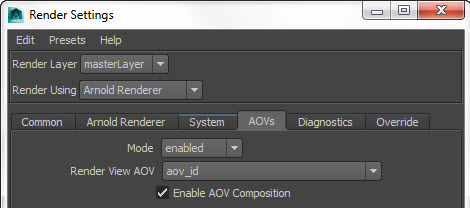
I don’t think this set up works if you plug a Standard into the beauty of the aiWriteColor (eg Standard > aiWriteColor > Standard). With that set of connections, I could never get the opacity right in both the Beauty and the Mask AOVs.
If you want to double-check what license servers Arnold is trying to connect with, set the log verbosity level to the maximum, and you’ll get something like this:
' INFO : [arnold] 00:00:00  438mb   [rlm] checking connection to license servers ...
' INFO : [arnold] 00:00:05  438mb   [rlm]  5053@STEPHEN-PC ... DOWN
' INFO : [arnold] 00:00:05  438mb   [rlm]  5053@SOLIDANGLE-PC ... UP
' INFO : [arnold] 00:00:05  438mb   [rlm] found 1 license servers
' INFO : [arnold] 00:00:15  438mb   [rlm] checkout of arnold (version 400) from SOLIDANGLE-PC OK
' INFO : [arnold] 00:00:15  438mb   [rlm] expiration date: 31-dec-2013 (190 days left)
You can use relative paths in Maya (like “/Dog.ass” in the Path box of the StandinShape attributes). It can be relative to the project, or relative to the Procedural Search Path.
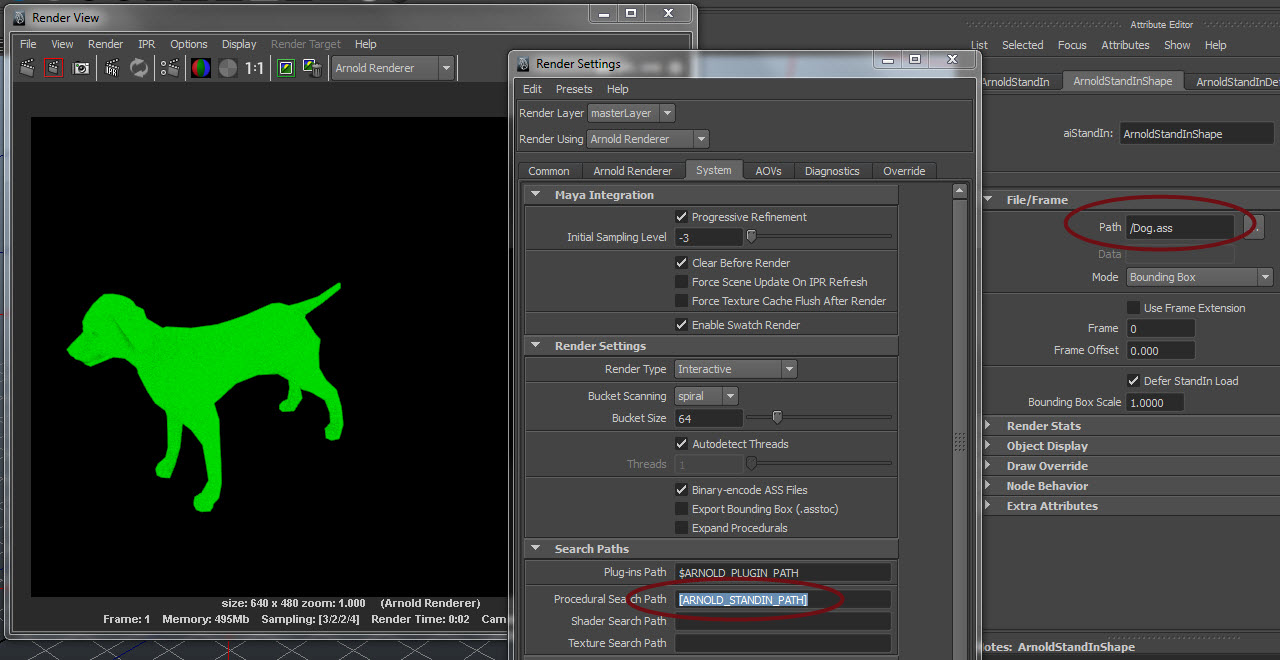
An exported ASS file, on the other hand, always has the full absolute path.
To load an animated sequence into a standin:
In this case, a customer running Maya 2013 on Ubuntu reported this error when he tried to load the mtoa plugin:
API error detected in plugins/mtoa/Main.cpp at line 710: (kFailure): Unexpected Internal Failure
ERROR | Failed to register renderer 'arnold'
That specific line in plugins/mtoa/Main.cpp runs these two lines of Python:
import mtoa.cmds.registerArnoldRenderer
mtoa.cmds.registerArnoldRenderer.registerArnoldRenderer()
So I asked the customer to run that Python in the Maya script editor, and that gave us this error:
# Error: ImportError: file
/usr/autodesk/maya2013-x64/lib/python26.zip/hashlib.py line 63: No module
named _md5 #
Now we’re cooking with EVIL gas! I’ve seen these kinds of errors before…
This appears to be general problem with Maya 2013 and pymel (I found a few different posts about this via Google search). For example, this thread from the pymel project, or the Troubleshooting section on this page.
In brief: you need to create some symlinks to the right versions of the libssl.

In this case, a user installed the latest MtoA, but when he went to load mtoa.mll in the Plug-in Manager, he got this error:
---------------------------
Settings/Preferences: maya.exe - Entry Point Not Found
---------------------------
The procedure entry point ?IsRenderablePath@CArnoldSession@@SA_NVMDagPath@@@Z could not be located in the dynamic link library mtoa_api.dll.
From past experience, I knew that the problem was probably the Maya.env file. And sure enough, it looked something like this:
MAYA_RENDER_DESC_PATH = C:\solidangle\mtoadeploy\2013.0.22.0
PATH = %PATH%;C:\solidangle\mtoadeploy\2013.0.22.0\bin;
solidangle_LICENSE=5053@SOLIDANGLE-PC

MAYA_RENDER_DESC_PATH = C:\solidangle\mtoadeploy\2013.0.22.1
PATH = %PATH%;C:\solidangle\mtoadeploy\2013.0.22.1\bin;
Notice that there are two MAYA_RENDER_DESC_PATH and PATH settings. Maya reads just the top two, which are for an older version of mtoa, so when Maya loads mtoa.mll we end up with a “missing entry point” error.
How did this happen? Well, in this case, in-between installs and uninstalls of different versions MtoA, the user had updated Maya.env with his own MAYA_RENDER_DESC_PATH and PATH settings for MtoA. And then the next install of MtoA appended its own settings to the Maya.env file.
The MtoA Installer works like this:
So if your Maya.env already has MtoA settings for MAYA_RENDER_DESC_PATH and PATH settings, then when you install another MtoA, you end up with a problem (because the new settings will be at the bottom, where they are ignored).
Ok, so that’s problem solved. Just remove those extra entries from Maya.env.
In this video, I show how to a color mask AOV using a custom AOV and the Utility shader. Topics covered include:
– Creating a custom AOV
– Setting the default shader for a custom AOV
– Setting up the Utility shader to output a color for each shape
– Understanding the difference between the Color and Color ID color modes
 Arnold Support Corner