The Arnold log. Don’t contact support without one 😉
Don’t know about the Arnold log? Don’t know how to get it? Google it.


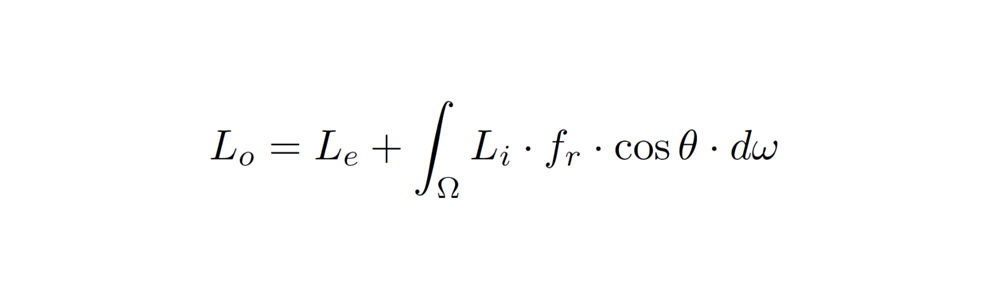
The Arnold log. Don’t contact support without one 😉
Don’t know about the Arnold log? Don’t know how to get it? Google it.
Or, “Understanding the Arnold log, part 23”
In this case, a client had very low (15%) CPU usage for a render. We got the Arnold log, and here’s the interesting part:
00:01:44  856MB   | OpenImageIO ImageCache statistics (0000000025850F20) ver 1.5.24
00:01:44  856MB   |   Images : 3 unique
00:01:44  856MB   |     ImageInputs : 299 created, 2 current, 3 peak
00:01:44  856MB   |     Total size of all images referenced : 192.4 MB
00:01:44  856MB   |     Read from disk : 12.0 GB
00:01:44  856MB   |     File I/O time : 45m 41.5s (48.1s average per thread)
00:01:44  856MB   |     File open time only : 0.0s
00:01:44  856MB   |   Tiles: 711523 created, 559 current, 640 peak
00:01:44  856MB   |     total tile requests : 249379431
00:01:44  856MB   |     micro-cache misses : 3353694 (1.34482%)
00:01:44  856MB   |     main cache misses : 711523 (0.285317%)
00:01:44  856MB   |     Peak cache memory : 10.0 MB
00:01:44  856MB   |   1 not tiled, 1 not MIP-mapped
00:01:44  856MB   | -----------------------------------------------------------------------------------
00:01:44  856MB   | performance warnings:
00:01:44  856MB   | Rendering utilization was only 15%. Your render may be bound by a single threaded process or I/O.
00:01:44  856MB   | -----------------------------------------------------------------------------------
0.285% means that texture tiles are loaded from disk (instead of from the in-memory texture cache) once out of every 350 texture lookups. That’s a little high.
* The main cache is the cache of 64×64 texture tiles loaded from disk into the texture cache.
Other clues to the too-small texture cache size:
The solution? Increase the size of the texture cache. The current default is 2048, which should be good in most cases.
Question: how do you set up the Arnold ambient_occlusion shader so that it ignores self-occlusion?
Let’s start with the default ambient occlusion. here’s a sphere and a plane. Each has it’s own Ambient Occlusion shader. For the sphere, Ambient Occlusion.Black is Red.

Now, let’s disable Receives Shadows on the sphere.
That means no occlusion based on the plane (shadow rays from the sphere ignore the plane); but there’s still self-occlusion.

Next, Cast Shadows disabled. No self-occlusion, but no ambient occlusion on the plane either

And finally, Self Shadows disabled. Now, there’s no self-occlusion. The ambient occlusion on the sphere is coming solely from the plane
In this case, a client reported a lot of noise in the shadows of his forest of opacity-mapped trees. In a progressive render, he saw lots of fireflies at the low AA levels, so it seemed to be something out of the ordinary, since he’d never had this problem before in other, similar scenes.
He managed the get rid of the noise by cranking up the light samples, the AA, and the transparency depth, at the cost of extremely long render times.
But sampling wasn’t the problem, or the solution, in this case. The problem was a large “sky” sphere that had the skydome HDR mapped to it. This sphere was just there to make the sky visible, but this sphere was visible to all ray types. The solution was to make the sphere visible to camera rays only.
Unlike a Skydome light, a textured sphere isn’t importance-sampled intelligently by Arnold. So you’ll get noise and fireflies from the random diffuse rays that happen to hit a super bright pixel in the sky texture.
hat tip: TI
The valence of a vertex is the number of edges connected to that vertex. In Arnold, the maximum valence is 255 (that’s because of the data type we use to store the valence; we minimize the memory requirements since this is stored per-vertex).
If a mesh in the scene has a vertex with more than 255 edges, you’ll get a WARNING like this:
[polymesh] example_mesh: mesh has at least a vertex with valence higher than 255, disabling subdivision
But if the adaptive subdivision results in a vertex with too many edges, you’ll get an ERROR:
ERROR: [arnold] [subdiv] example_mesh: edge (144578,287741) in face 263433 has a vertex that exceeded the max valence limit of 255
With the default Diffuse = 2 sampling, you’ll get four diffuse rays for each camera ray. Those four diffuse rays are the first bounce after the camera ray “hits” a shape.
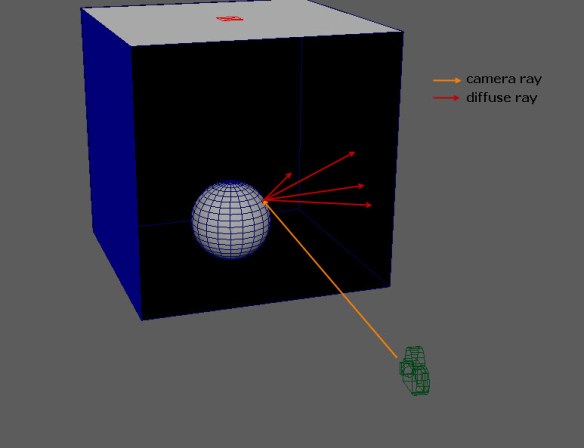
After the first bounce, Arnold sets all the sampling settings back to 1, so for each of those four diffuse rays, you get one second-bounce diffuse ray. This prevents an exponential explosion of rays as secondary rays like diffuse rays bounce around a scene.
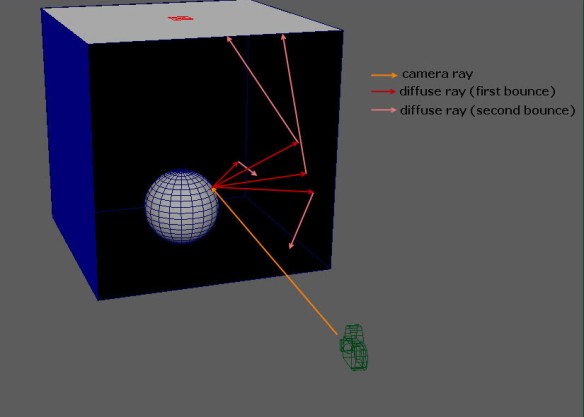
The same thing is true for the other secondary rays such as glossy, refraction, and shadow rays.
So, in summary:
I have another, more general, version of this post here. This one is for new Arnold users with Maya 2017.
Here’s what to do if you get errors like this:
// Error: file: C:/Program Files/Autodesk/Maya2017/scripts/startup/autoLoadPlugin.mel line 32: Unable to dynamically load : C:/solidangle/mtoadeploy/2017/plug-ins/mtoa.mll
The specified module could not be found.
//
// Error: file: C:/Program Files/Autodesk/Maya2017/scripts/startup/autoLoadPlugin.mel line 32: The specified module could not be found.
As of Arnold 4.2.16.2, the SSE requirement is now SSE4.1
If this is the first time you’ve tried to use the Maya to Arnold (MtoA) plugin, then check whether your processor supports SSE4.1.
If MtoA used to load, but now it doesn’t, then something happened to the MtoA installation. I’ve seen several cases where DLLs were missing from the MtoA bin folder; most importantly, Arnold itself was missing (Arnold is ai.dll on Windows, or libai.so on Linux, or libai.dylib on OSX).
If you make a backup copy of the MtoA install folder, we can investigate after you fix things by installing MtoA.
If a clean install of MtoA doesn’t work (and the computer does support SSE4.1), then “The specified module could not be found.” usually means there’s a missing dependency. Dependency Walker is a decent, if aging, tool for checking out dependencies, but for leaving no stone unturned, I prefer Process Monitor.
The MtoA plugin (mtoa.mll) depends on a handful of files only. Here’s the log of loaded DLLs for a working MtoA:
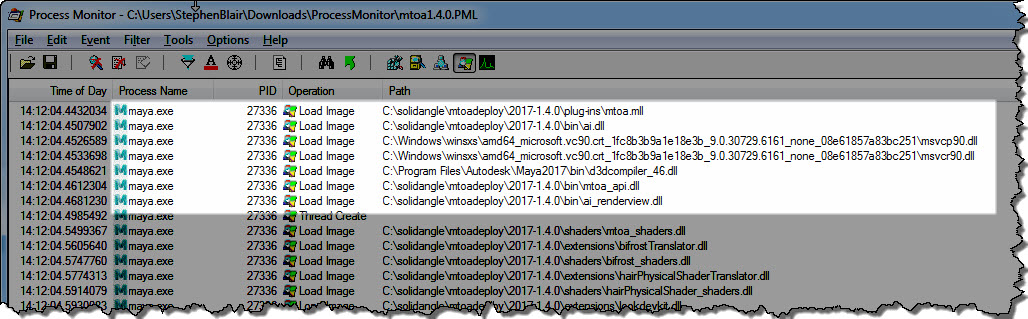
Here’s a quick walkthrough (no audio) of how to get a Process Monitor log:
For example, can I transfer Arnold shaders from 3ds Max to Maya? Or from Houdini to Maya?
The answer is no. The Arnold plugins don’t include code for reading shader nodes from an ASS file and creating shader trees inside the host application (eg Maya, Houdini, or Cinema 4D).
You can use ASS files to take shapes and shaders from one app and render them in another app, but those shapes and shaders are never created inside the other app.
An MtoA Standin (aka an Arnold Procedural in HtoA and C4DtoA) references an ASS file, and passes that on to Arnold at render time.

The ASS file contains Arnold nodes (shapes and shaders). Those Arnold nodes are not created inside the 3D application.
Instead, the standin node is translated to an Arnold procedural node, and at render time, that procedural node is expanded, and all the Arnold shapes and shaders are created inside the Arnold scene.
As of Arnold 4.2.16.2, the requirement is now “just” SSE4.1.
This blog post is for Google search to find; I’ve already blogged about the SSE4.1 requirement elsewhere.
If your processor does not support SSE4.1, the Arnold won’t run on your computer. MtoA will either fail to load, or you’ll get a crash whenever you try to render.
To check whether an older machine supports SSE4.1, here’s a few suggestions:
A note about coreinfo:
SSE4.1 * Supports Streaming SIMD Extensions 4.1
SSE4.1 - Supports Streaming SIMD Extensions 4.1
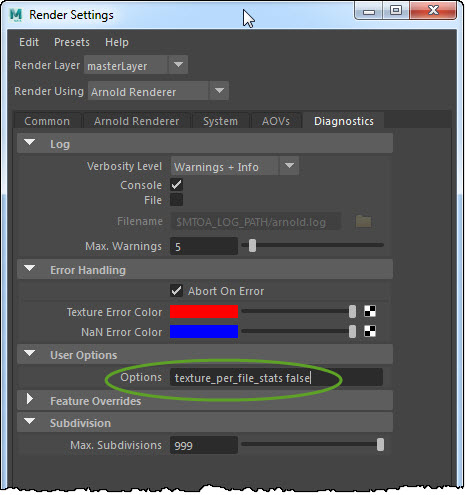
Here’s a good example of why you might use the User Options, and how it lets you set Arnold parameters that aren’t exposed by MtoA in Maya.
If you set the verbosity level to Warnings + Info, you’ll get some detailed image statistics in the Arnold log:
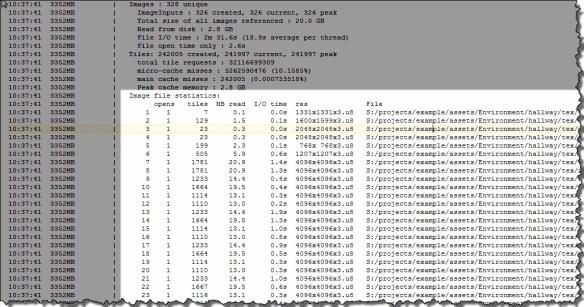
But what if you’ve got thousands of image files (eg udims)? You might not want all that in your log. There used to be a check box in the Arnold Render Settings that allowed you to turn off the detailed image file statistics, but we removed that a few years ago.
But the Arnold options.texture_per_file_stats parameter is still there, so you can use the User Options field to set that parameter to false. Just enter the parameter name “texture_per_file_stats” and the parameter value, like this:
 Arnold Support Corner