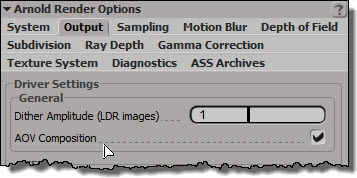
AOV Composition and opacity


AOV Composition allows opacity and transparency to carry forward into AOVs. It works only for RGB AOVs, so you won’t see it in the render region (because the xsi display driver always outputs RGBA AOVs).
aov_composition

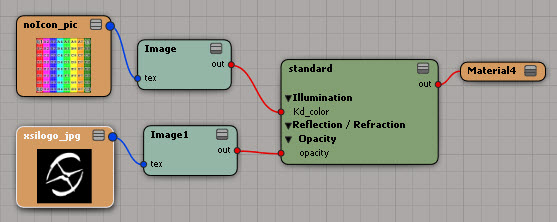
For example, suppose you have a textured grid with an opacity map:
noicon_grid_w_opacity_map
In the render region, the Main AOV is fine, but the Arnold Direct Diffuse doesn’t have the opacity, even if you enable AOV Composition:
main_vs_direct_diffuse1
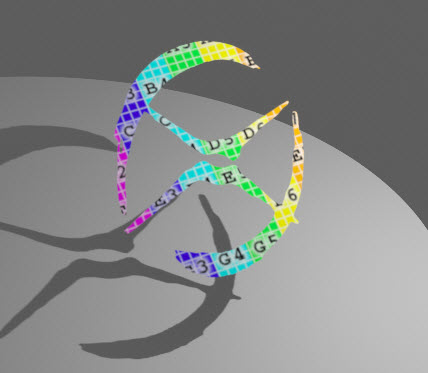
However, if you render out the image (with AOV Composition enabled and the Direct Diffuse format set to RGB), you’ll get what you expected:
arnold_direct_diffuse_aov_composition

SITOA: Adding Arnold materials through scripting


If you want to apply Arnold materials through scripting, there are a couple of undocumented commands you can use:

  • SITOA_AddMaterial takes the shader family (for example, Material or Texture) and the name of a shader, and connects that shader to the surface port on the Material node.
    # Add a standard material to the selected object
    SITOA_AddMaterial( "Material", "standard" )
    
    # Add ambient_occlusion to the selected object
    SITOA_AddMaterial( "Texture", "ambient_occlusion" )
    
  • SITOA_AddShader is similar, but it also takes a connection point as an argument, so you can connect to a specific port, such as the Environment or Displacement port.
    # Add a vector displacement shader
    SITOA_AddShader("Texture", "sta_vector_displacement", "displacement" )
    

However, neither of these commands return anything. So if you wanted to name the material, it’s not so easy. SITOA_AddMaterial does apply to the selection, so you could go through the selection to get the new material:

# Python
Application.SITOA_AddMaterial("Material", "standard")
sel = Application.Selection
mat = sel(0).Material
mat.Name = "MyStandardMaterial77"

You could write your own function with X3DObject.AddMaterial.

Here’s the simplest possible version. I don’t specify the path to a preset, just the name of the shader. That’s not terribly efficient, because Softimage now has to search for the preset (and that took about 0.2 seconds on my machine).

si = Application

def add_material( o, shader_name ):
	return o.AddMaterial( shader_name )

mat = add_material( si.Selection(0), 'Material', 'Standard' )
mat.Name = 'My_Standard_Mat'

Here’s a version that builds the path to the preset (just like the SITOA commands do), but that doesn’t require the shader family, just the name of the shader.

# dictionary of shader families, keyed by shader name
shader_types = {
  'ray_switch' : 'Material' , 
  'sta_vector_displacement' : 'Texture' , 
  'wireframe' : 'Material' , 
  'sta_displacement' : 'Texture' , 
  'ambient_occlusion' : 'Texture' , 
  'skin_sss' : 'Material' , 
  'sta_camera_projection' : 'Texture' , 
  'utility' : 'Texture' , 
  'bump3d' : 'Texture' , 
  'standard' : 'Material' , 
  'complex_fresnel' : 'Texture' , 
  'bump2d' : 'Texture' , 
  'motion_vector' : 'Material' , 
  'hair' : 'Material' , 
  'noise' : 'Texture' , 
  }


si = Application

def add_material( o, shader_name ):
	arnoldPlugin = si.plugins("Arnold Shaders");
	dspresets = XSIUtils.BuildPath( arnoldPlugin.OriginPath, '..', '..', 'Data', 'DSPresets' )
	mat = None
	if shader_name in shader_types:
		preset = XSIUtils.BuildPath( dspresets, 'Shaders', shader_types[shader_name], '%s.Preset' % shader_name )
		mat = o.AddMaterial( preset )
	return mat


mat = add_material( si.Selection(0), 'noise' )

mat.Name = 'My_Noise'
The case of the license server that wasn’t releasing licenses


In this case, a customer reported that the license server wasn’t releasing licenses when a render node crashed.

Why did this happen? Because the customer had an older version of the license server that didn’t have a license TIMEOUT.

Since early 2012, the Solid Angle license server ships with a default TIMEOUT of 120 seconds. That means if a workstation stops sending heartbeats to the license server, then after two minutes the license server takes back the license. So, for example, if a workstation crashes or disconnects from the network, then the license server will take back the license after a couple of minutes.

The TIMEOUT is specified in a solidangle.opt file located in the RLM folder, along with rlm.exe and solidangle.set. Newer versions of the Solid Angle license server ship with this options file, but if you don’t have it, you can either upgrade your RLM or create the file yourself. Here’s what it should look like:

TIMEOUT 120 arnold

You’ll need to restart the server to read the new options.

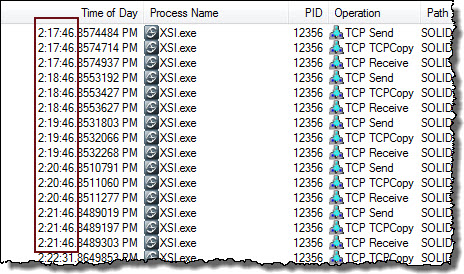
What are heartbeats? Heartbeats are messages sent from a licensed application to the license server while the application has one or more licenses checked out from the server. You can see them with Process Monitor. In this screenshot, you can see that XSI.exe is sending a heartbeat every one minute to the license server.
heartbeats

If you need to free a checked out license, you can “remove” it (that’s RLM-speak for taking back a checked out license).

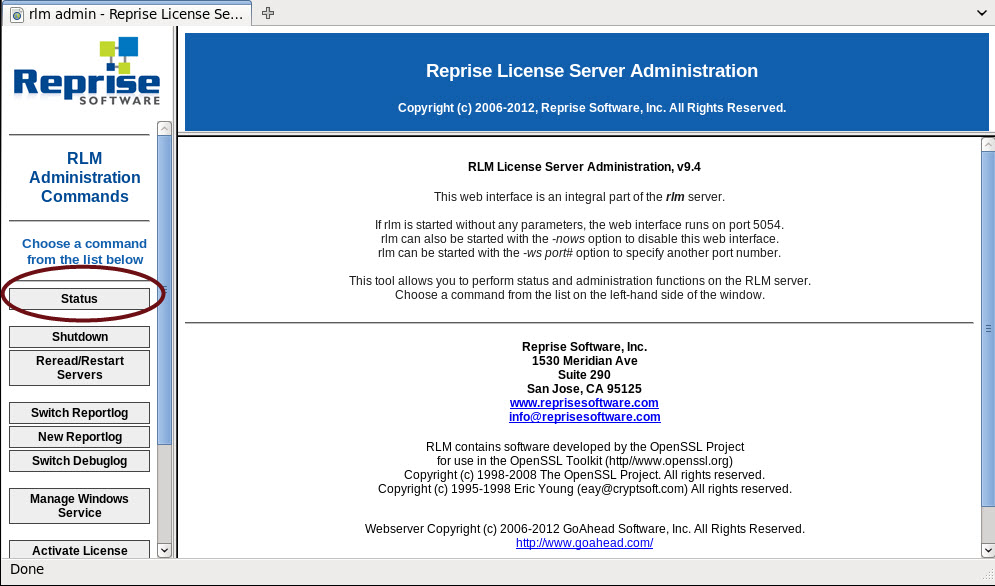
To remove a license in rlm admin (localhost:5054):

  • Click Status.
    Status
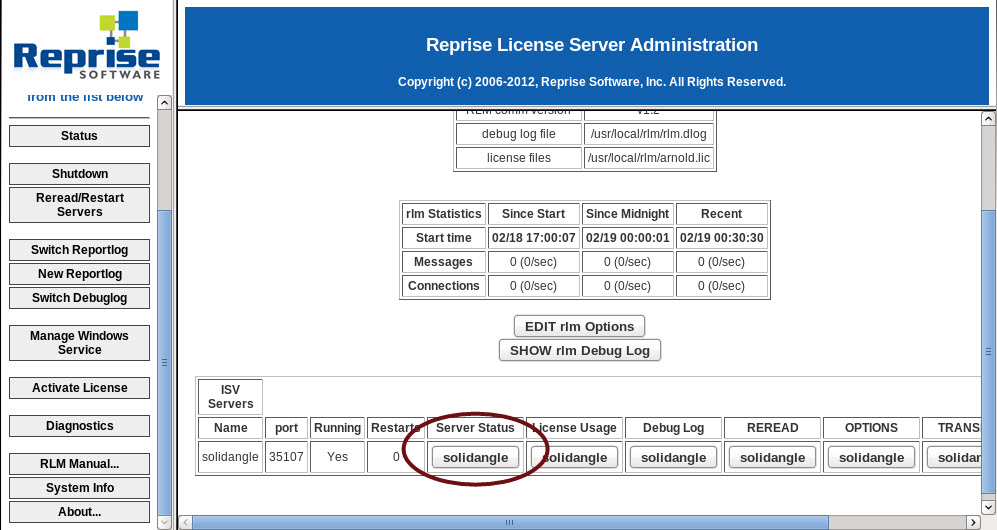
  • Under Server Status, click solidangle.
    ServerStatus
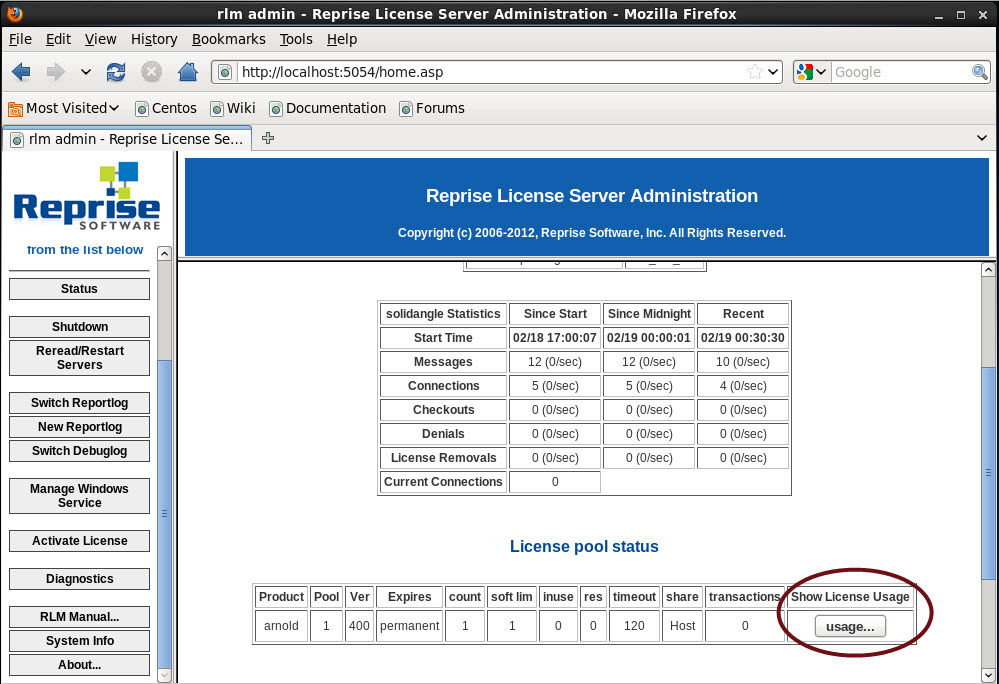
  • Under Show License Usage, click Usage.
    ShowLicenseUsage
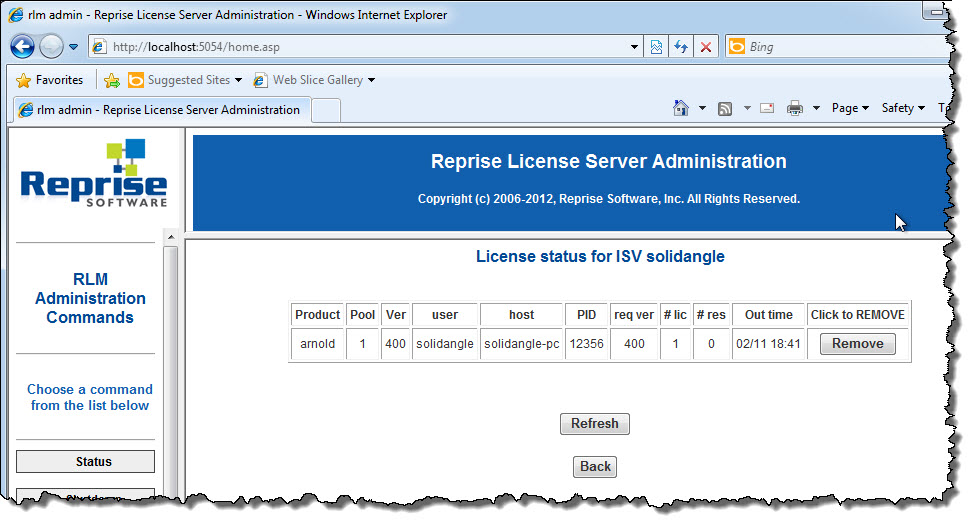
  • Click Remove.
    LicenseUsage-Remove

Pref coordinates and bind poses


The Noise shader can use different coordinate systems when it evaluates the noise.

  • Object space, where points are expressed relative to the local origin (center) of the object.
  • World space, where points are relative to the global origin of the scene.
  • Pref, which isn’t really a space, but rather a reference to a bind pose, which in Softimage is the top of the Modeling region. Pref is really a point in object space, but it’s a reference to the geometry at the top of the Modeling region. In constrast, if you use Object space, you’re getting point position coordinates from the very top of the whole operator stack.

Noise_Coords

The name “Pref” is easier to understand if you think of it like a variable name. So, when it comes to noise, P is a point in world space, Po is in object space, and Pref is in “reference space” aka the “bind pose”.

For the Noise shader, the advantage of using Pref is that it prevents the noise from swimming over the surface of the object as the object deforms (as long as the deforms are above the Modeling stack). As the object deforms, Po is a point on that deformed geometry, so Po is constantly changing. In contrast, Pref is a point on the geometry that came out of the Modeling stack. So the noise sticks to the “bind pose”.

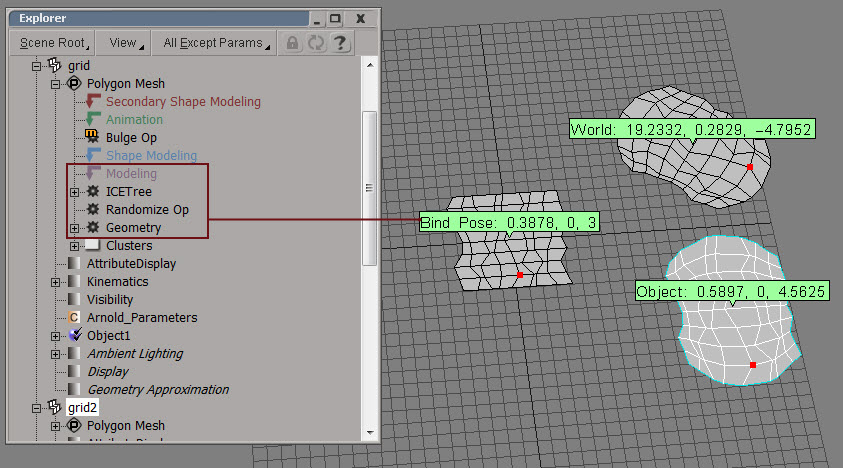
Note the difference between Pref and the two other coordinate systems (World and Object).
BindPose

Noise, world coordinates, and offsets


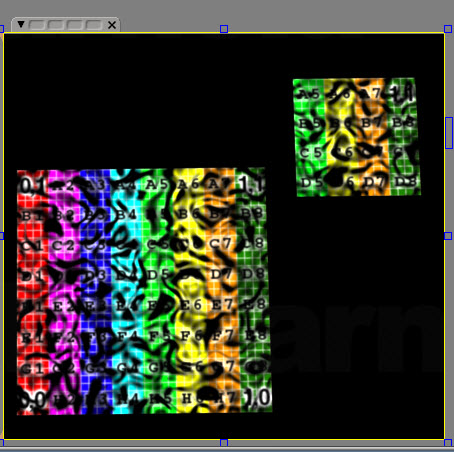
If you’re using world coordinates for your noise, then obviously as an object moves in global space, the noise will change. Here I’ve extracted a polygon and moved it: same shader tree that uses noise, but different noise because I’m using world coordinates.
noise_world

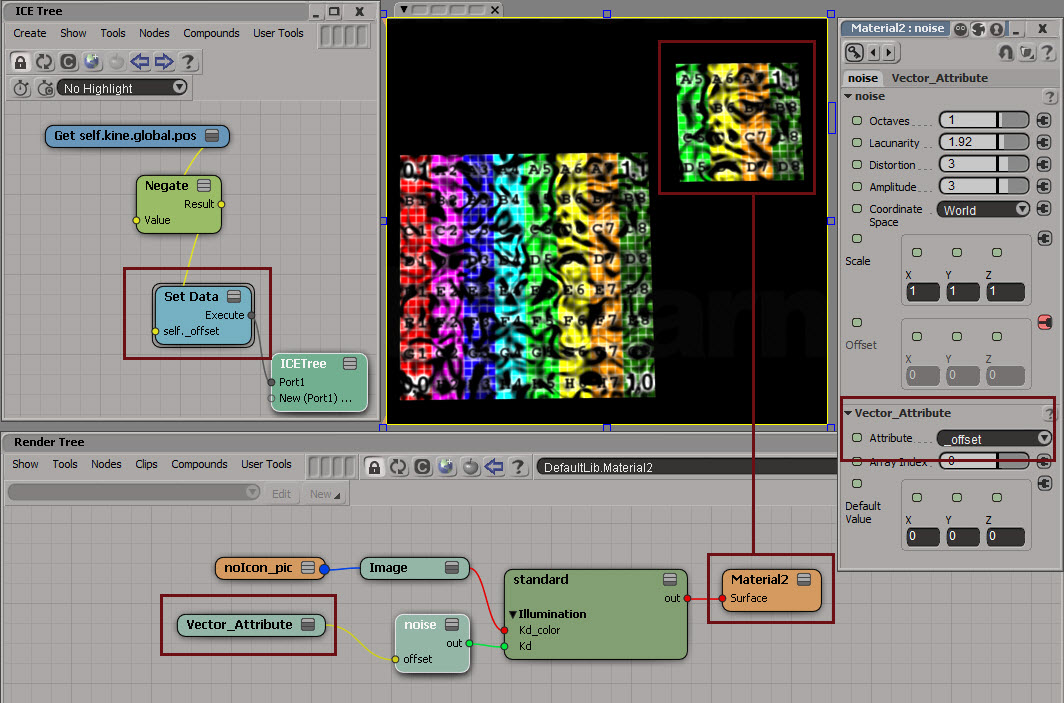
You could keep the same noise by applying an offset equal to the translation:
noise_world_offset_1
Note that I’ve assumed that there’s no scaling of the noise. If there was, I’d have to multiply my offset by the same scaling.

Just for kicks: listing the available shaders


Want to know what shaders come with SItoA?

Use kick -nodes with the -l flag to get a list of all nodes. For example:

kick -nodes -l %SITOA_BINDIR%\sitoa_shaders.dll | find "shader"

where SITOA_BINDIR is just shorthand for the Application\bin\nt-x86-64 folder of your SItoA addon install. On my machine, that’s here:

C:\Users\SOLIDANGLE\Documents\Workgroups\sitoa-2.6.0-2013\Addons\SItoA\Application\bin\nt-x86-64

The output will list the builtin Arnold shaders first (such as ambient_occlusion, standard, and wireframe), and then the SItoA shaders (which start with the two BA_ shaders).

In general, you wouldn’t include a filename in the -l path. I included sitoa_shaders.dll so kick wouldn’t try to load sitoa_curves_proc.dll and then pop up a “sicppsdk.dll is missing” error because I’m not running kick in a Softimage command prompt (where all the Softimage environment variables are set for me).

So, a more general example would look like this:

kick -nodes t -l %SITOA_BINDIR%

-nodes t will sort the list of nodes by type.

Missing shaders in images rendered with kick


pink_elephant

I was tempted to title this post something like “why is my ass pink when I kick it???” 🙂

The color magenta (often reported as “pink” or even “purple” sometimes) is the color of missing shaders. If Arnold cannot find a shader, it returns the color magenta (RGB = 1, 0, 1). This is a pretty common result when people export an ASS file from Maya for the very first time. Unlike SItoA, which helpfully fills in the Shader Search Path for you, MtoA leaves the search paths empty (unless you fill them in yourself).

There’s several ways you can tell kick where to find the shaders:

  • Use the kick -l flag to specify the location of the shaders. For example:
    kick -l C:\solidangle\mtoadeploy\2013\shaders
  • Set the ARNOLD_PLUGIN_PATH environment variable to the location of the shaders.
  • In Maya, enter the shader search path in the Render Settings before you export the ass file.

I thought you might also be able to use -set options.shader_searchpath on the kick command line, but that didn’t work for me.

kick -i "elephant.ass" -set options.shader_searchpath "C:\solidangle\mtoadeploy\2013\shaders"

Using the attr token in the texture file name attribute of a File node


In this blog post, I’ll quickly step through an example of how to use the <attr> token in the Maya File node.

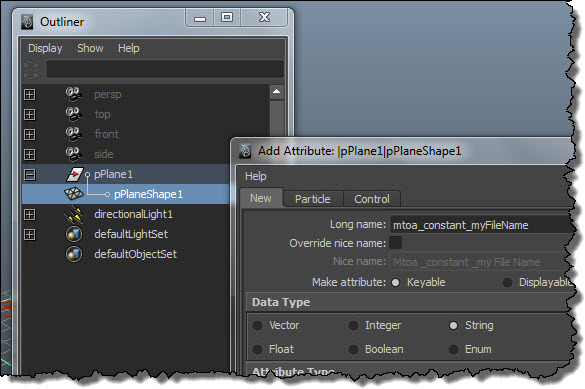
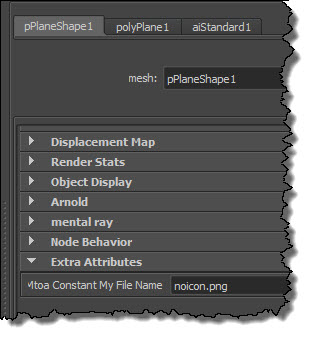
Add a "mtoa_constant_" attribute to the shape node.
attr_AddAttribute

Put the name of the texture file in the extra attribute:
attr_ExtraAttributes

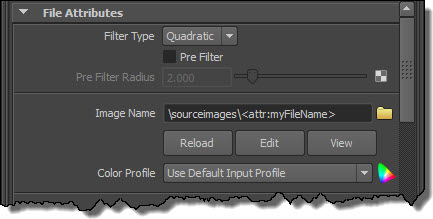
Use the token in the Image Name. Note that I have a relative path, so I have to make sure that I’ve set a project.
attr_ImageName

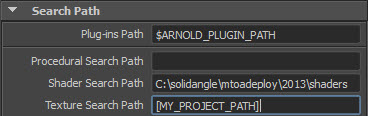
Now I’ve got something that will render in Maya. If I want to export this to an ASS file and render it with kick, I need to add a Texture Search Path (and optionally, a shader search path if I don’t want to use kick -l).
attr_SearchPaths

Here’s the texture-related parts of the exported ASS file:

options
{
 ...
 texture_searchpath "[MY_PROJECT_PATH]"
 ...
}

polymesh
{
 name pPlaneShape1
 ...
 declare myFileName constant STRING
 myFileName "noicon.png"
}

standard
{
 name aiStandard1
 Kd_color file1
}

MayaFile
{
 name file1
 filename "/sourceimages/<attr:myFileName>"
}

Notice how MtoA exported a relative path instead of an absolute. This happens only if you have a token in the filename; otherwise, you always get an absolute path.

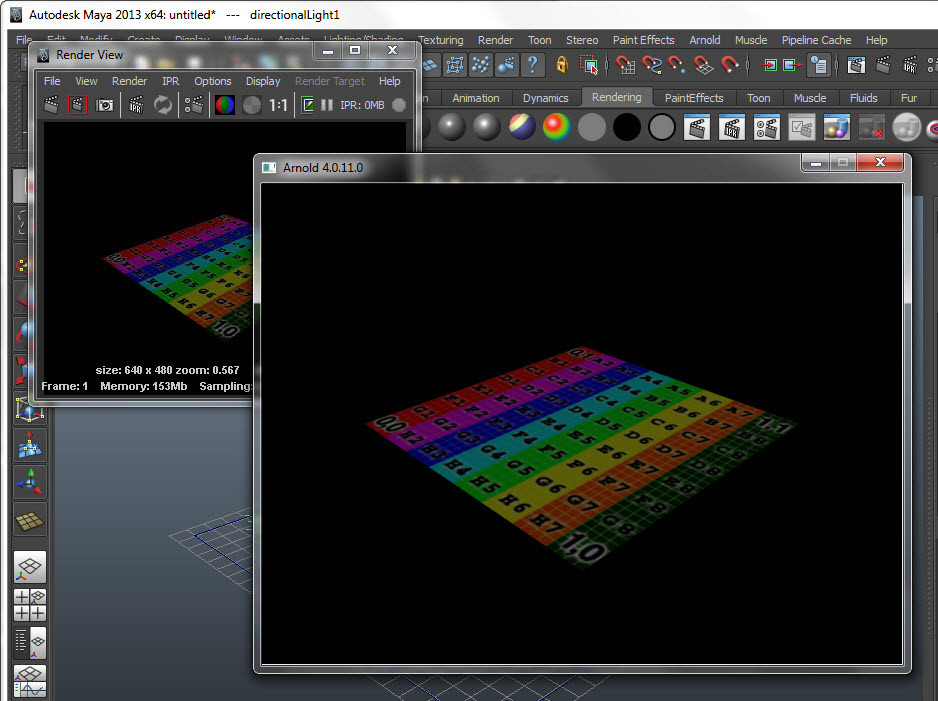
And here’s a screenshot to show all this working, both in Maya and in Arnold:
attr_Render

Using environment variables in Arnold search paths


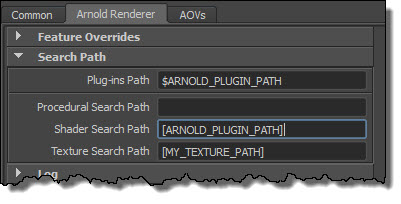
To use an environment variable in one of the Arnold search paths, you just have to put the environment variable in square brackets [ ].

For example, [ARNOLD_PLUGINS_PATH] or [MY_TEXTURE_PATH].
Maya-Arnold-SearchPaths

A search path can include many paths; just use a semi-colon (;) to separate each path. For example, here’s a search path that includes three different locations:

[ARNOLD_PLUGINS_PATH];[USERPROFILE]\Dev\shaders\bin\Release\x64;[MY_PLUGINS_PATH]